
How to Control Content Visibility Within WooCommerce Products
Table of contents
WooCommerce’s own Catalog visibility setting, in the Publish box of the product editor, decides whether a whole product appears in the shop and in search results. To show or hide parts of a product page instead, such as a video, a size guide or a notice, build the product template with Elementor and add rules with Visibility Logic Pro: the Post/Page condition matches products by category, product type or ID, and the WooCommerce Users condition matches customers by what they bought.
Both are Pro conditions. Below are the two kinds of rules with a worked example each, and the limits worth knowing.
What do you need?
- WooCommerce.
- Elementor, plus a way to edit the single product page in Elementor. Elementor Pro’s Theme Builder has a Single Product template; some themes offer their own.
- Visibility Logic for Elementor (free) and Visibility Logic Pro, both active.
Two kinds of rules
| You want to decide by | Use | Example |
|---|---|---|
| Which product is being viewed | Post/Page | A size guide only on products in the “Shoes” category |
| Who is viewing it | WooCommerce Users | A setup video only for customers who bought the product |
Example 1: A video only on variable products
The single product template shows a “How to choose your variant” video. It makes sense on variable products and is noise on simple ones.
- Open the Single Product template with Elementor and select the Video widget.
- Open the Visibility tab. Older versions called it Stax Visibility.
- In the General section, switch Enable Visibility Logic to Yes and set Show/Hide action to Show.
- Open the Post/Page section and switch Enable to Yes.
- Set Custom Post Type to Products, Taxonomy to Product type (product_type) and Terms to variable.
- Click Update and open a variable and a simple product.
WooCommerce stores the product type as a taxonomy, which is why it shows up in the Taxonomy list. The same approach works with Product categories or Product tags as the taxonomy, or with specific products in the Post/Page field.
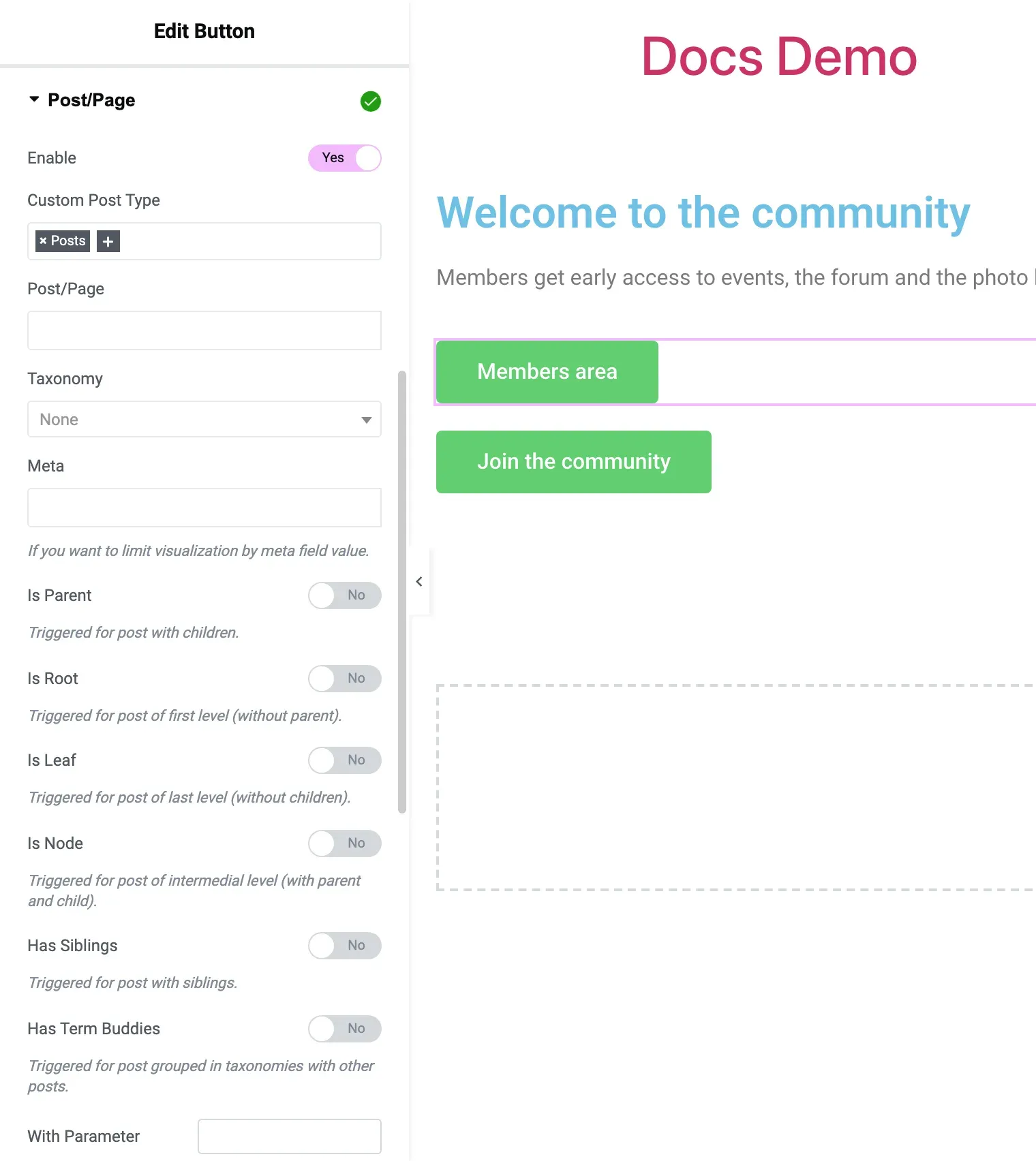
Each field you fill in Post/Page is a separate check, combined by Conditions Type in the General section. With All (the default), the product must pass every one, which is what you want here: it is a product and it is variable. See Post and Page.
Example 2: A setup video only for buyers
The product page is public, but the setup video is a perk for customers.
- Select the video in the Single Product template and enable Visibility Logic with Show/Hide action set to Show.
- Open the WooCommerce Users section and switch Enable to Yes.
- Set Condition to User has purchased specific product, pick the product in Product, and leave Products Condition on At least one.
- Click Update.
The other options are User has purchased any product and User has purchased specific product variation. With WooCommerce Subscriptions active, you also get User has any active subscription and User has specific active subscription. Only paid orders (processing or completed) count, and only subscriptions with the status Active. Details in WooCommerce Users.
The condition reads the orders of the logged-in customer. Logged-out visitors never match.
A useful pair on the same template: hide a “Frequently bought together” upsell from customers who already own the product (action Hide), and show them a link to the manual instead (action Show), both with the same WooCommerce Users condition.
Rules for shop pages
Visibility Logic Pro also has conditions for the pages around the product:
- Conditional Tags, Page list: matches WooCommerce pages such as Shop, Product, Cart, Checkout, Account page and Order complete. Use it for elements in a header or footer template that should appear only on some of them.
- Archives: matches the shop page or a product category archive.
Limits worth knowing
- Catalog visibility is a different tool. To keep a whole product out of the shop or search results, use WooCommerce’s Catalog visibility setting. Visibility Logic controls elements inside a page you build in Elementor.
- A hidden element is not a protected file. If a hidden section links to a download or a page, that target is still reachable by anyone who has the URL.
- Caching. Product-based rules are the same for every visitor of a product and work with a page cache. Customer-based rules depend on the visitor; most caches skip logged-in users, which keeps them correct, but check your cache. See Rules look wrong for some visitors.
- HPOS. If User has purchased any product never matches on an older version, update Visibility Logic Pro to 2.4.2 or newer, which reads orders through WooCommerce and works with High-Performance Order Storage (troubleshooting).
With Pro, the Fallback section can show a text or an Elementor template in place of a hidden element, for example “Buy this product to unlock the setup video” (fallback content).
Free or Pro?
Post/Page, WooCommerce Users, Conditional Tags and Archives are all part of Visibility Logic Pro. The free plugin includes User Role, User Meta, Date Time, Browser Type, Device Type and ACF Field, which already covers “only for logged-in customers” style rules. Pro costs $29 per year for 1 site, $39 for 3 sites and $79 for 100 sites, with a 30-day money-back guarantee. See the Free vs Pro table.
Selling digital products with Easy Digital Downloads instead? See Visibility Logic with Easy Digital Downloads.
The short version
Use WooCommerce’s Catalog visibility for whole products. For parts of a product page, build the template in Elementor and add Visibility Logic Pro rules: Post/Page to decide by product, category or type, WooCommerce Users to decide by what the logged-in customer bought. Get Visibility Logic Pro.